France
Promise at DawnIn Promise at Dawn, France is not merely the country in which Romain Gary hopes to make a life or for which he fights in the Second World War. It begins as a country imagined for him by his mother, a story of justice and greatness that gives shape to his ambitions. When history and French institutions contradict that story, he does not simply abandon it: he must decide what kind of France deserves his loyalty, and what belonging to it entails.
A country first encountered through stories
Before France becomes a place he can inhabit, it is a landscape of maternal storytelling. In the Lithuanian forest, his mother presents the country as a fairy tale, making its history and culture part of their intimate life together. Her accounts of Joan of Arc and the taking of the Bastille sit alongside nursery stories, while the fables of La Fontaine help him learn to read. Even the French language comes to feel like his mother tongue. The country reaches him through her voice and expression; its imagined beauty is inseparable from his love for her.
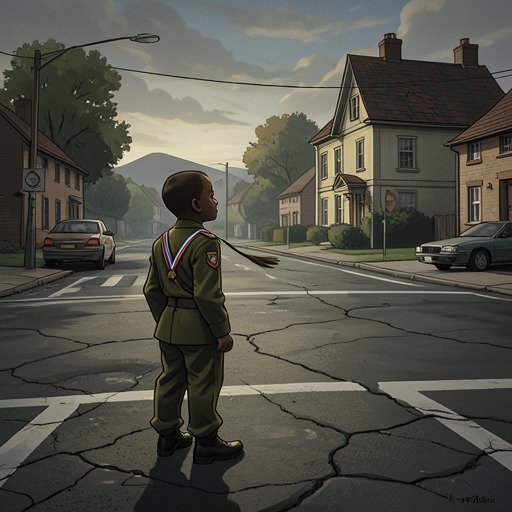
This education gives France an extraordinary emotional authority. As a child, he arranges lead soldiers on the floor and imagines himself leading armies; the historical world is not distant fact but material for play and aspiration. His mother’s ideal is also a promise about his future. When hardship returns, she tells him he will become an Ambassador of France, a destiny she regards as the least he should achieve. Diplomacy is, in her eyes, a fitting place among the best people, and the ambassador’s uniform represents distinction. France therefore arrives not only as a homeland but as the setting for a life that must vindicate her hopes.
The fairy tale meets history
The adult narrator understands that his mother’s France was a highly imaginative vision, one that collided with the country’s turbulent and contradictory reality. Yet the collision cannot undo the earlier formation. He says that even living in France cannot free him from the fairy tale: the inherited image remains a measure against which the actual country is judged. His attachment is thus neither simply patriotic certainty nor uncomplicated disillusionment. The ideal persists, but experience forces him to distinguish it from the people and institutions that claim to represent it.
That distinction is visible in his early understanding of danger. His mother’s patriotic confidence has formed a kind of protective barrier around him. He trusts the French Army and its leaders and does not read the silence in France as a reason for alarm. He recalls learning only at the Nice lycée that France had been defeated in 1870; his mother had omitted the episode. The omission exemplifies how her narrative protects the child from facts that might unsettle the country’s invincibility. Before the war, he has paid little attention to events in Europe and cannot readily comprehend Adolf Hitler or the Nazis. What looks like calm strength to him is partly the consequence of having been raised inside a system of reassuring certainties.
The ideal is tested decisively when France is defeated in 1940. He had never imagined that his country could lose, in part because he believes his mother’s life cannot end in defeat. When he hears Charles de Gaulle’s appeal on June 18, however, France is no longer only the country of his mother’s childhood stories. He recognizes in the general’s words the voice of the woman who sold hats at their former address. He rallies without hesitation to both voices at once: the public call to continue fighting and the private authority that first taught him what France meant. The remembered voice of his mother makes resistance personal, while the appeal gives her intimate ideal a political form.
Belonging challenged by institutions
His loyalty does not spare him from exclusion within the country he claims as his own. At the French Air Force flight school, he is told that he has been failed because he was born in Russia and his naturalization is too recent. The rule discussed in that conversation restricts a flying officer’s eligibility to those born to French parents or naturalized for more than ten years. Though the rule had been criticized as undemocratic and discriminatory and was said not to be applied, it is invoked against him. His protest that he is French meets a dismissive response rather than recognition.
The rejection produces a paradoxical change. He later identifies the painful experience as the moment he felt truly French, as though he had at last been assimilated. The country ceases to appear as a collection of superior beings set apart from others. French people, like everyone else, can be foolish, ridiculous, and unjust; France contains a thousand faces, noble and repellent alike. He must choose which of those faces resembles the country his mother described. Instead of allowing a flag to settle the question, he tries to choose his allegiances by looking at the people who hold it. France becomes a commitment requiring judgment, not a guarantee of moral perfection.
Service, survival, and a promise to return
His service gives that commitment practical consequences. At the outbreak of war, he is working as an air-gunnery instructor at Salon-de-Provence. His mother travels there by taxi to say goodbye, bringing food and supplies intended for his officers rather than for him. He explains his confidence in victory through her: her life, and the sacrifices behind it, seem to him to demand a victorious ending. In 1940, he continues to expect France to recover even as military events overturn his assumptions. His mother’s vision does not make him a detached observer; it gives him a reason to fight and a standard by which surrender feels intolerable.
That standard also shapes his response to severe illness during the war. He understands his survival as bound to obligations he has not yet fulfilled: returning home with victories, writing a great novel, and becoming an Ambassador of France. These aims combine personal ambition with his mother’s hopes and his sense that a life must acquire meaning through what it accomplishes. His eventual recovery does not end his service. He returns to operational flying, and when his squadron transfers to England in 1943, he works on A European Education alongside his military duties. He imagines that his mother will have to accept literary recognition in place of the military glory she had hoped for him, but that her artistic ambitions for him will still be realized.
Return and the meaning of France
As the war nears its end, literary and military achievement converge in his plans to go home. He sends word to his mother that he has received the Cross of the Liberation and that his book has brought her some measure of the artistic fame she imagined. Her letters convey joy and tenderness, along with an apology whose reason he does not yet understand. He anticipates arriving with honors, his novel, and the prospect of a diplomatic career: the objects and credentials of a returned French serviceman become signs that his years away have led toward the reunion he has long promised himself.
On the return journey, he pictures the Mediterranean as an old nurse welcoming him and understands the homecoming through companionship, justice, and reason. The scene is not merely a return to a national territory. It gathers the strands that have made France meaningful: the mother’s original promise, the choice to continue fighting after defeat, the recognition that French society is imperfect, and the hope that sacrifice can contribute to a more honorable world. In the memoir, France’s importance lies in that unresolved movement between ideal and reality. The country cannot remain the untouched fairy tale of childhood, but neither does its failure to match that tale erase the attachment. It becomes a homeland he has to choose and serve with open eyes.